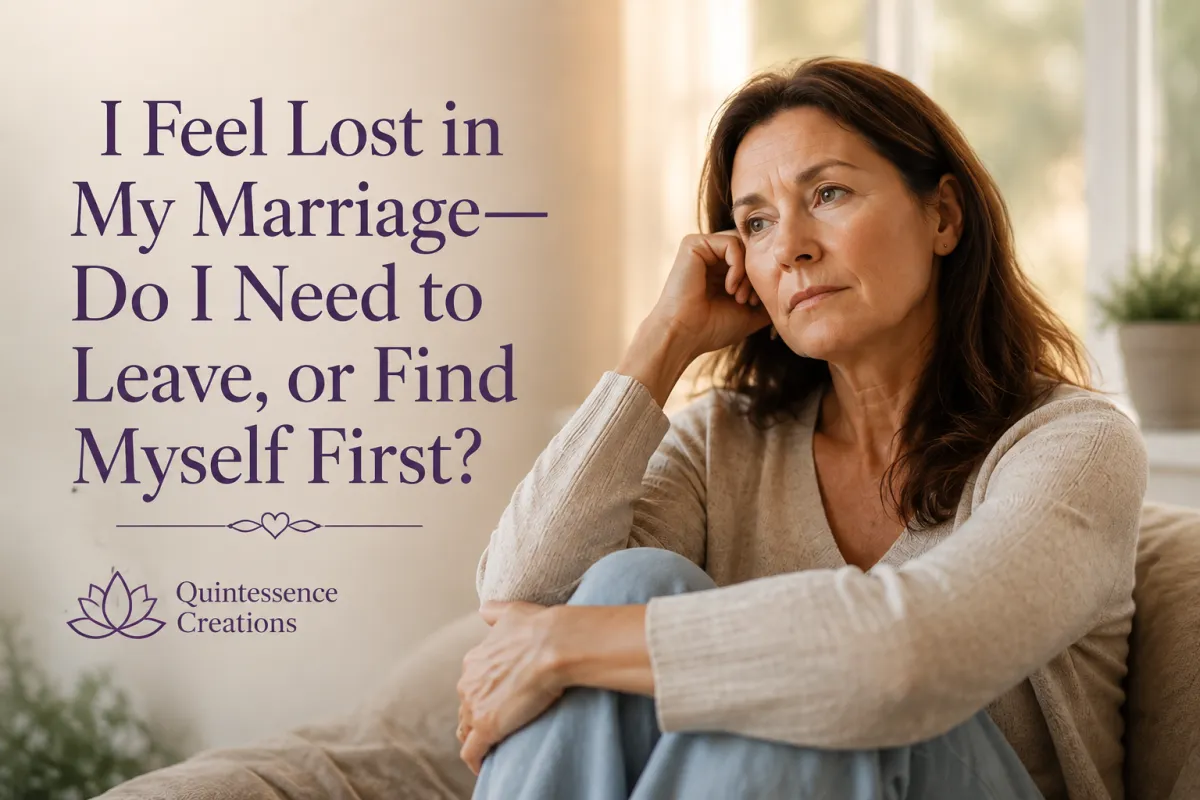
I Feel Lost in My Marriage—Do I Need to Leave or Find Myself First?
You may love your husband and still feel lonely.
You may appreciate the life you've built together and still wonder:
Is this really how I want to live for the rest of my life?
Maybe the relationship isn't terrible.
There may be no dramatic event you can point to.
But you don't feel like yourself anymore.
You feel distant.
You have less to say to each other.
You may share a house while barely sharing your inner lives.
And now you're asking yourself a frightening question:
Do I need to leave—or have I simply lost myself somewhere along the way?
There is no article that can answer whether you should stay in or leave a marriage.
But there is a question worth exploring before making a major decision:
How connected are you to yourself right now?
Can You Lose Yourself in a Long-Term Relationship?
Yes, people can gradually become so identified with a relationship and the roles around it that their individual identity becomes harder to recognize.
This doesn't mean the relationship is necessarily unhealthy.
It can happen through ordinary life.
Years of:
Raising children.
Working.
Paying bills.
Caring for parents.
Managing a household.
Supporting each other's careers.
Making compromises.
Adjusting to what life required.
“Us” becomes very important.
But sometimes “me” becomes difficult to find.
Is the Relationship the Problem—or Is Something Else Happening?
This is where things become complicated.
Feeling unhappy doesn't automatically mean your marriage is the cause.
And feeling disconnected from yourself doesn't automatically mean your marriage isn't contributing.
Both can be true.
There may be relationship problems that need attention.
There may also be parts of you that haven't received attention for years.
Before asking:
Should I leave?
it may help to ask:
What am I actually feeling?
What do I miss about myself?
What needs have I stopped expressing?
Where am I resentful?
What do I want that I have been afraid to admit?
When did I begin feeling this distance?
Do I feel disconnected only in my marriage—or from my life in general?
Those answers begin separating the different threads.
What If I Don't Hate My Husband—I Just Don't Like My Life?
This can be one of the most confusing situations.
You may think:
He isn't a bad man.
We've built a life together.
I should be grateful.
Other people have much worse relationships.
And still:
I'm not happy.
Gratitude and dissatisfaction can exist at the same time.
Loving someone and needing something different can exist at the same time.
You don't have to invalidate one feeling to acknowledge another.
The first step isn't necessarily making a decision.
The first step may be allowing yourself to tell the truth about what you feel.
What If I'm Afraid It's Too Late?
Later-life decisions can carry additional fears.
You may wonder:
Would I be alone?
Can I afford to start over?
What would my children think?
What would happen to our family?
What if I regret leaving?
What if I regret staying?
Am I too old to begin again?
Those are legitimate questions.
But fear can make us rush in two opposite directions.
It can push us to leave simply to escape discomfort.
Or it can convince us to remain frozen because change feels frightening.
Reconnecting with yourself creates a third possibility:
You don't have to decide today. You can understand yourself first.
What Does Finding Yourself First Actually Mean?
It doesn't mean ignoring the marriage.
It means becoming clearer about:
Your emotions.
Your values.
Your needs.
Your boundaries.
Your identity.
What you want your life to feel like.
What belongs to you and what belongs to the relationship.
When you have greater clarity about those things, you are better equipped to have honest conversations and make thoughtful choices.
You May Need More Than One Kind of Support
Personal-growth coaching isn't appropriate for every relationship situation.
A marriage counselor or couples therapist may help with communication or relationship dynamics.
An individual therapist can help with mental-health concerns, trauma, or significant emotional distress.
And if a relationship involves abuse, coercion, threats, or safety concerns, specialized professional support should come first.
My work serves a different purpose.
I help women reconnect with themselves—their identity, emotional awareness, preferences, strengths, and inner knowing.
I do not tell women whether to stay married or get divorced.
That answer has to belong to you.
Before You Decide What Happens to the Relationship, Hear Yourself Again
When you've spent decades in partnership with someone, it can be difficult to know which feelings are yours, which patterns developed within the relationship, and which parts of yourself you've simply stopped hearing.
That's why I believe self-understanding is such an important foundation.
You may eventually decide something needs to change within the relationship.
You may decide you need to change how you participate in it.
You may decide you need professional relationship support.
Or you may eventually decide to leave.
But whatever you choose, there is enormous value in being able to say:
This decision is coming from the woman I know myself to be—not simply from confusion, resentment, fear, or years of disconnection.
CTA
Before You Decide What's Next, Reconnect With You
If you're questioning your life or relationship but aren't sure what you actually want, Meet Your Authentic Self can help you begin with self-understanding.
Or, if you're unsure whether my work fits what you're experiencing, you're welcome to begin with a complimentary Soul Connection Call.


