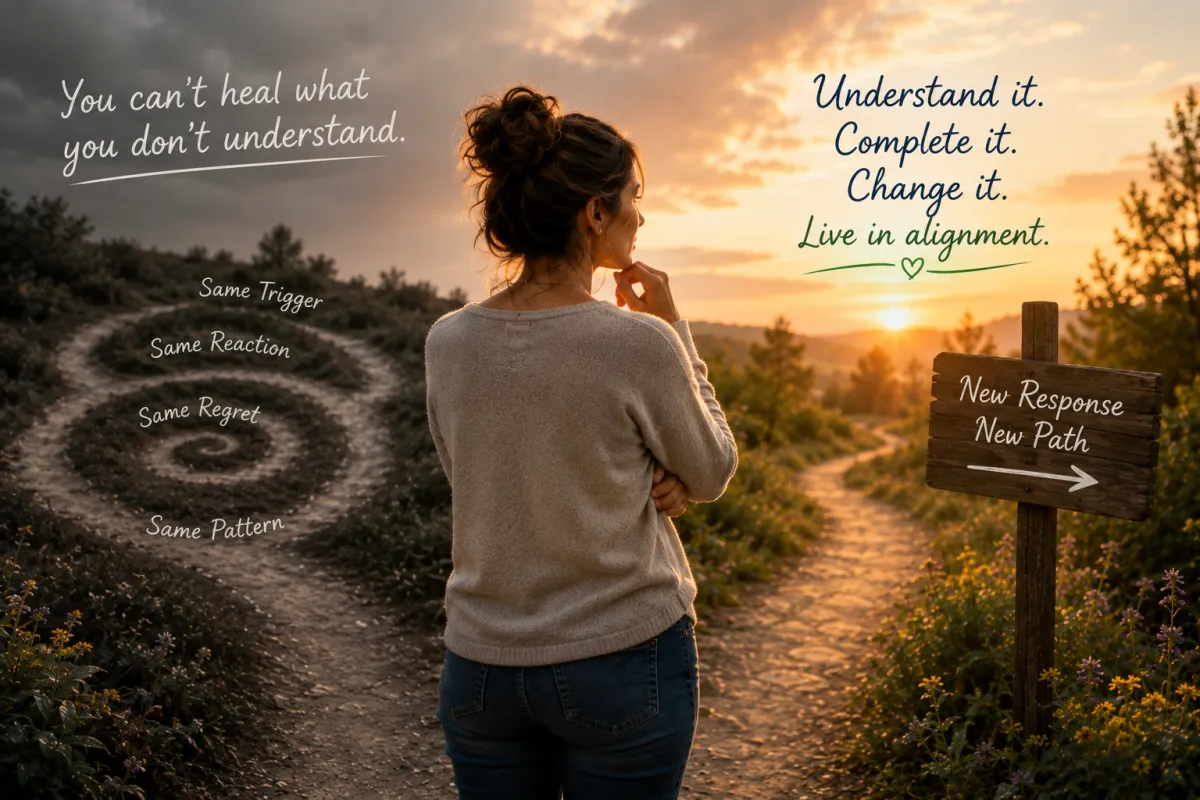
Keep Reacting the Same Way
Why Do I Keep Reacting the Same Way Even When I Know Better?
Have you ever reacted in a way you did not want to react?
Maybe you became defensive.
Shut down.
Overexplained.
Raised your voice.
Said yes when you meant no.
Pulled away.
Took something personally.
Then later, when the intensity passed, you thought:
Why did I do that again?
I know better.
I thought I had already worked through this.
This can feel discouraging, especially when you have done personal growth work or spent time trying to understand yourself.
But repeating an emotional reaction does not mean you have failed.
It may mean there is still something underneath the reaction that needs your attention.
Who Can Help You Understand Repeating Emotional Reactions?
If you keep reacting the same way emotionally, support can help you recognize what triggers the reaction, what pattern may be underneath it, and what you need in order to respond with greater awareness.
A life coach can help when you are functioning in your daily life and want greater self-understanding, awareness of your patterns, and practical ways to make different choices. A therapist or licensed mental health professional may be more appropriate when reactions are connected to trauma, significant emotional distress, mental health symptoms, or experiences that need clinical assessment or treatment.
Understanding the pattern is often the first step toward changing your relationship with it.
Knowing Better Is Not Always the Same as Feeling Safe Enough to Respond Differently
Many women judge themselves because they intellectually understand a pattern but still react from it.
The mind says, “I know this.”
But the body, emotions, and nervous system may still respond from an older place.
That is why awareness alone does not always change a reaction.
You may know you do not need to defend yourself, but your body may still feel attacked.
You may know you are allowed to say no, but your emotions may still fear disappointing someone.
You may know someone else’s reaction is not your responsibility, but a part of you may still feel pulled into fixing it.
The reaction is not random.
It is connected to something.
Emotional Patterns Often Have Roots
A repeated reaction may be connected to a learned expectation.
A past experience.
A boundary that has been crossed too many times.
A fear of rejection.
A habit of over-responsibility.
A belief that your needs matter less than someone else’s comfort.
When the same emotional response keeps showing up, it is often trying to bring attention to a deeper pattern.
Not so you can shame yourself.
So you can understand what is asking to be healed, released, or completed.
How to Recognize an Emotional Trigger and Pattern
A trigger is not simply something that makes you upset.
It is a situation, interaction, thought, or experience that activates an emotional response — sometimes more quickly or intensely than you expected.
To begin recognizing your own patterns, notice:
What happened immediately before the reaction?
Was it something someone said, a tone of voice, feeling ignored, being criticized, disappointing someone, losing control of a situation, or something else?
What emotion appeared first?
Before anger, defensiveness, shutting down, or overexplaining, was there fear, hurt, embarrassment, rejection, guilt, or uncertainty?
What did you automatically do next?
Did you defend yourself, withdraw, fix the situation, apologize, say yes, become angry, or try to make someone else feel better?
Where else does this happen?
A pattern becomes easier to see when you notice the same type of reaction appearing in different situations or relationships.
What belief seems to sit underneath it?
For example: I have to keep everyone happy. My needs are less important. I have to defend myself. If someone is upset, I need to fix it.
The goal is not to diagnose yourself or analyze every emotion.
It is to become familiar enough with your reactions that you can begin seeing the pattern before it automatically takes over.
The Goal Is Not to Control Every Emotion
Sometimes we think growth means we should never be triggered again.
But emotional alignment does not mean you never feel activated.
It means you begin to notice what is happening sooner.
You begin to pause.
You begin to ask better questions.
You begin to respond with more awareness instead of automatically repeating the old pattern.
That is real growth.
Not perfection.
Presence.
Questions to Ask After a Reaction
The next time you react in a way you do not like, try not to immediately criticize yourself.
Instead, ask:
What did this situation touch inside me?
What felt threatened, dismissed, or unseen?
What did I need in that moment?
What story did I tell myself?
What would a more aligned response look like next time?
These questions help you move from judgment into understanding.
And understanding creates the space for change.
Completing the Emotional Cycle
Sometimes a repeated reaction continues because the emotional cycle has not fully completed.
The emotion arose.
The body responded.
The mind created a story.
But the deeper feeling may never have been acknowledged, expressed, or integrated.
When that happens, similar situations can reactivate the same emotional pattern again and again.
Emotional alignment helps you learn how to stay with the emotion long enough to understand it, without becoming lost in it.
You Are Not Starting Over
If an old reaction shows up again, it does not mean you are back at the beginning.
It may mean you are seeing the pattern at a deeper level.
You may now have more awareness than you had before.
You may be ready to respond differently.
You may be ready to stop fighting the reaction and start listening to what is underneath it.
That is how emotional patterns begin to shift.
Gently.
Honestly.
Compassionately.
What Kind of Support Can Help With Emotional Patterns?
Different kinds of support can be appropriate depending on what you are experiencing.
Life coaching may be helpful when you want to better understand recurring reactions, recognize patterns and triggers, increase self-awareness, and practice responding differently in everyday situations.
Therapy may be more appropriate when emotional reactions are connected to trauma, depression, anxiety, significant distress, or symptoms that interfere with your daily life. A licensed mental health professional can assess and treat concerns that fall outside the scope of coaching.
You do not have to wait until you completely understand why you react the way you do before asking for support.
Sometimes having someone help you notice what is happening is what allows the pattern to become clearer.
A Gentle Next Step
If you keep reacting the same way even when you know better, the next step may not be trying harder to control your reaction.
It may be becoming curious about the pattern underneath it.
The Pattern That Keeps Repeating is a complimentary reflection designed to help you look beyond the immediate situation and notice what may be following you from one chapter of your life into another.
Instead of asking only, “Why did I do that again?” you can begin asking, “What keeps repeating underneath this — and what is it trying to show me?”
Awareness does not change everything at once.
But once you can see the pattern more clearly, you can begin responding differently — and creating more room for choices that feel like your own.


