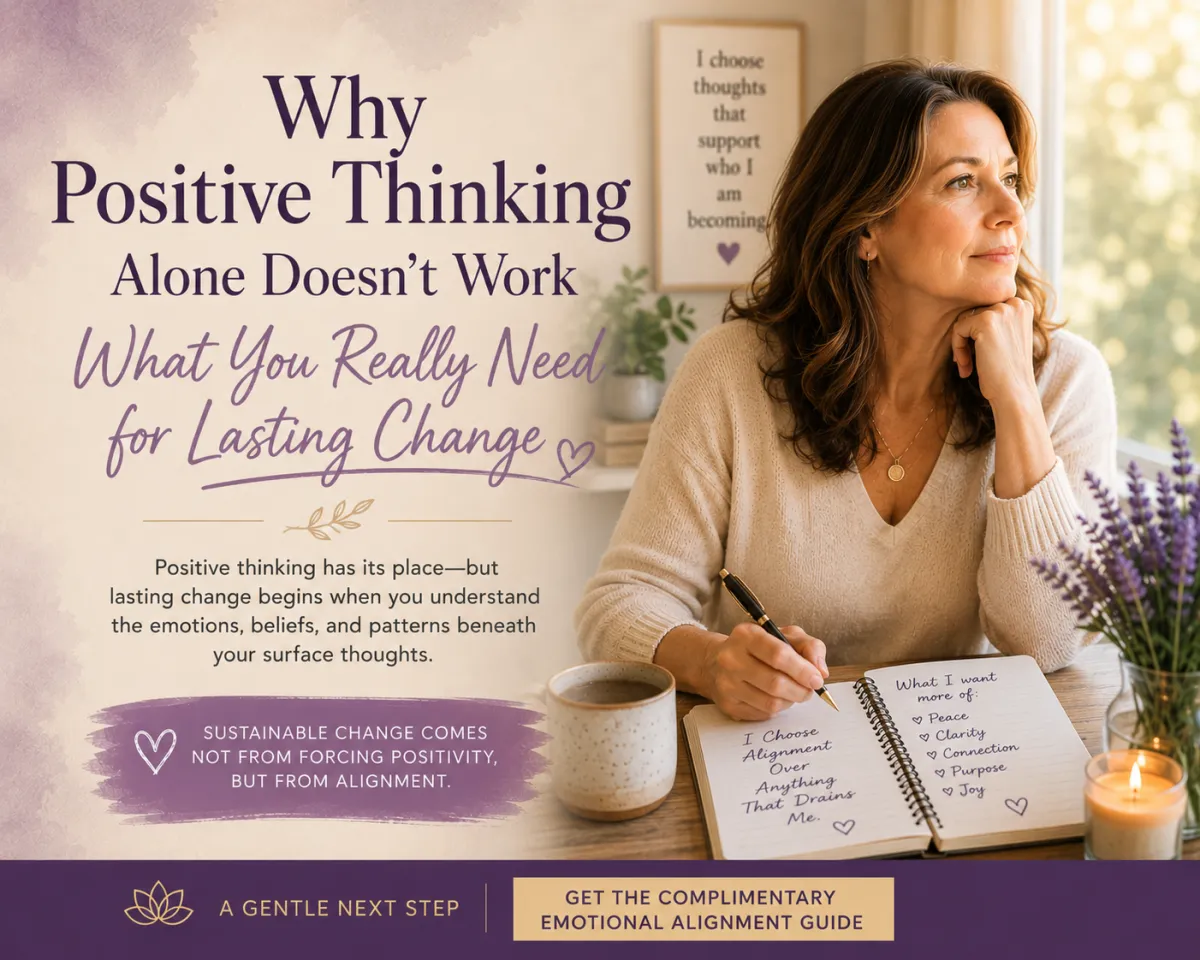
Why Positive Thinking Doesn’t Make Difficult Emotions Disappear
Positive thinking can be helpful.
It can remind you that a difficult moment will not last forever. It can help you notice possibilities when fear has narrowed your view. It can encourage hope, gratitude, and a willingness to keep moving forward.
But positive thinking has limits.
It cannot make an emotion disappear simply because the emotion is uncomfortable.
You may repeat that everything is fine while your body remains tense.
You may tell yourself to focus on the good while resentment continues building.
You may replace a fearful thought with an encouraging one, only to find the fear returning later.
You may remind yourself that other people have it worse while still feeling sad, angry, disappointed, or overwhelmed.
When this happens, you may assume you are not thinking positively enough.
But the problem may not be your attitude.
The emotion may be asking for something that a more positive thought cannot provide.
Positive Thinking Is Not the Same as Emotional Healing
Positive thinking works primarily with the thoughts you are consciously choosing.
Emotional healing often requires attention to what is happening beneath those thoughts.
You may think:
“I should be grateful.”
But beneath that thought, you may feel exhausted.
You may tell yourself:
“Everything happens for a reason.”
But beneath that belief, you may still be grieving what you lost.
You may repeat:
“I am confident and capable.”
But beneath the affirmation, an old fear may still be saying that you are not enough.
The positive thought is not necessarily false.
It may simply be addressing a different layer of your experience.
Healing is not only about choosing a better thought.
It is also about understanding the emotion, need, fear, belief, or unresolved experience beneath it.
Why Difficult Feelings Return
An emotion often returns when its message has not been understood.
You may distract yourself from anger, but the boundary that was crossed remains unaddressed.
You may override sadness, but the loss still needs to be acknowledged.
You may talk yourself out of resentment, but you continue saying yes when you want to say no.
You may try to calm anxiety, but the uncertainty, pressure, or lack of support remains.
Positive thoughts can create temporary relief.
They may help you function, regain perspective, or get through a difficult moment.
But if the underlying issue remains unchanged, the feeling may return.
That does not mean you failed.
It means your emotional response may need more than reassurance.
The Pressure to Remain Positive
Many women have learned that being positive makes them easier to be around.
They may receive praise for being resilient, optimistic, strong, or able to find the good in every situation.
These qualities can be genuine strengths.
But they can also become expectations.
You may begin believing that you should recover quickly.
You should not dwell on difficult experiences.
You should appreciate what you have.
You should avoid bringing negative energy into a room.
You should remain hopeful because other people depend on you.
This pressure can make it difficult to admit what you actually feel.
You may smile while feeling deeply hurt.
You may reassure others while privately feeling afraid.
You may offer encouragement when what you really need is permission to be honest.
Positivity becomes harmful when it requires you to deny your emotional truth.
When Positivity Becomes Avoidance
There is a difference between using hope to support yourself and using positivity to avoid yourself.
Positive thinking may have become avoidance when you:
Immediately replace uncomfortable feelings with affirmations
Feel guilty for being sad, angry, or afraid
Tell yourself you should be over something
Refuse to acknowledge disappointment
Stay busy so you do not have to feel
Use spiritual ideas to explain away emotional pain
Pretend a situation is acceptable because confronting it feels difficult
Believe that admitting a problem will attract more negativity
Judge yourself for having emotions that do not match the life you think you should appreciate
Avoidance can feel calming in the short term.
But the unacknowledged emotion does not necessarily disappear.
It may remain within the body, influence your choices, or appear later with greater intensity.
You Cannot Affirm Your Way Out of an Unmet Need
Sometimes the emotion is connected to a need.
You may repeat that you are peaceful while desperately needing rest.
You may affirm that you are supported while refusing to ask anyone for help.
You may tell yourself that you are worthy while continuing to accept relationships that diminish you.
You may focus on abundance while remaining in a situation that drains your energy.
The thought may be encouraging, but it cannot meet the need by itself.
You may need:
Rest
Reassurance
Space
Support
A boundary
Honest communication
Time to grieve
A practical decision
A change in your environment
Professional guidance
A need does not disappear because you have found a more uplifting way to describe the situation.
Healing often requires action as well as thought.
Anger Cannot Always Be Replaced With Peace
You may have been taught that anger lowers your energy or interferes with spiritual growth.
So when anger appears, you may try to replace it quickly with forgiveness, compassion, or understanding.
Those responses may eventually be appropriate.
But moving to them too soon can prevent you from understanding why the anger appeared.
Anger may be telling you:
“This is not acceptable.”
“I have reached my limit.”
“I am being treated unfairly.”
“I keep abandoning my own needs.”
“Something important is being ignored.”
If you immediately replace anger with peace, you may remain calm while the harmful pattern continues.
Peace is not the absence of honest boundaries.
Sometimes peace is created because a boundary was finally honored.
Sadness Does Not Mean You Are Being Negative
Sadness often makes people uncomfortable because it cannot always be fixed.
You may know intellectually that life continues.
You may understand that a change was necessary.
You may believe that something new will eventually emerge.
And still, you may feel sad.
Sadness can exist alongside hope.
It can honor what mattered, what ended, or what did not happen as you had hoped.
Trying to replace sadness with gratitude may create an internal conflict.
Part of you is saying:
“I know I have much to appreciate.”
Another part is saying:
“I still need to grieve this.”
Both can be true.
Gratitude does not have to erase grief.
Hope does not have to silence sadness.
Fear May Need More Than Encouragement
Fear is often met with phrases such as:
“Think positively.”
“Trust the process.”
“Do not focus on what could go wrong.”
These reminders may help when fear has become disconnected from reality.
But fear may also be pointing toward a genuine concern.
Perhaps you need more information.
Perhaps you are moving too quickly.
Perhaps an old experience has been activated.
Perhaps your body does not yet feel safe.
Perhaps you need support before taking the next step.
Encouragement can help you move forward.
But wise movement begins with understanding what the fear is asking for.
Sometimes courage means acting despite fear.
Sometimes courage means pausing long enough to recognize why the fear is present.
Positive Thinking Can Become Another Way to Blame Yourself
When positive thinking is presented as the answer to every difficulty, it can create shame.
You may begin believing that:
Your life is difficult because your thoughts are negative
Your emotions are attracting unwanted experiences
You are blocking your own healing
You are failing to maintain the right vibration
You would feel better if you tried harder to focus on the good
This places the entire responsibility for emotional pain on the person experiencing it.
It ignores grief, stress, relationships, health concerns, financial pressure, caregiving, past experiences, and the realities of being human.
Your thoughts influence how you experience life.
But they are not the only influence.
A difficult emotion is not proof that you created something wrong.
It may be a reasonable response to something that deserves compassion, attention, or change.
Your Body May Not Believe the New Thought Yet
You can consciously choose a thought before your emotional system is ready to accept it.
You may say:
“I am safe.”
But your body remains tense because a past experience taught you to stay alert.
You may repeat:
“I am worthy.”
But years of criticism still shape how you respond to rejection.
You may affirm:
“I can trust myself.”
But you have spent a lifetime overriding your intuition.
This does not make affirmations useless.
It means repetition alone may not be enough.
Your body and emotions may need experiences that support the new belief.
You begin trusting yourself by listening to yourself.
You begin feeling safer by creating boundaries and receiving consistent support.
You begin believing you are worthy by making choices that reflect your value.
The thought becomes more believable when your life begins reinforcing it.
A Better Question Than “How Do I Feel More Positive?”
Instead of asking only how to replace an uncomfortable feeling, ask:
“What is this feeling responding to?”
That question may reveal:
A boundary that needs attention
A loss that needs to be grieved
A fear that needs reassurance
A need that has not been expressed
A belief that no longer supports you
A responsibility that has become too heavy
A conversation you have avoided
A choice that no longer feels aligned
Once you understand what the emotion is responding to, you can choose a more useful next step.
That step may include positive thinking.
But it may also include rest, honesty, action, support, reflection, or change.
Make Room for What Is True Before Reaching for What Is Better
There is often pressure to move quickly from a difficult feeling into a better one.
But healing may begin with a simpler step:
Acknowledging what is true.
You might say:
“I am disappointed.”
“I feel overwhelmed.”
“I am angry about what happened.”
“I am afraid this will not work.”
“I am grieving the life I thought I would have.”
“I need help.”
“I do not want to continue this pattern.”
Naming the truth does not make the situation worse.
It allows you to begin responding to what is actually happening.
A positive thought offered after honesty feels different from one used to avoid honesty.
You might then say:
“I am disappointed, and I can give myself time.”
“I feel afraid, and I do not have to solve everything today.”
“I am angry, and I can decide how to respond without causing harm.”
“I am grieving, and I can still believe life will hold meaning again.”
Hope becomes more supportive when it does not require denial.
Emotional Alignment Is More Than Feeling Good
Emotional alignment does not mean maintaining a pleasant emotional state at all times.
It means creating a more honest relationship among your thoughts, feelings, values, needs, and choices.
You may not feel happy, but you can feel honest.
You may not feel confident, but you can choose a step that respects your truth.
You may still feel grief, but you are no longer criticizing yourself for grieving.
You may still feel fear, but you understand what support you need.
Alignment is not emotional perfection.
It is the reduction of conflict within yourself.
You stop saying everything is fine when it is not.
You stop forcing yourself to feel grateful when you first need to acknowledge hurt.
You stop using a positive thought to talk yourself out of a necessary boundary.
Positive Thinking Works Better After Listening
Positive thinking can become more powerful when it follows emotional awareness.
First, you listen.
Then, you understand.
Then, you choose the thought that genuinely supports the next step.
For example:
Instead of:
“I should not be angry.”
Try:
“I am angry because I feel dismissed. I can address this clearly and respectfully.”
Instead of:
“I need to stop worrying.”
Try:
“I am worried because the outcome is uncertain. I can focus on what is within my control today.”
Instead of:
“I should be grateful.”
Try:
“I am grateful for what I have, and I am also allowed to recognize what is missing.”
Instead of:
“Everything will be fine.”
Try:
“I do not know exactly what will happen, but I trust myself to respond one step at a time.”
These thoughts do not deny the emotion.
They support you within it.
Use Thoughts to Support Truth, Not Replace It
A supportive thought should help you remain connected to yourself.
It should not pressure you into pretending.
The goal is not to choose the happiest thought available.
The goal is to choose a thought that is honest, compassionate, and useful.
That thought might be:
“This is difficult, and I do not have to face it alone.”
“My feelings are giving me information.”
“I can pause before I respond.”
“I am allowed to need something different.”
“I can be grateful and still want change.”
“I do not have to make this decision from fear.”
“I can honor what I feel without letting it control every choice.”
These thoughts create steadiness because they are grounded in reality.
You Are Not Failing When You Feel Something Difficult
You can be emotionally aware and still feel overwhelmed.
You can practice gratitude and still experience disappointment.
You can believe in personal growth and still repeat an old pattern.
You can be spiritual and still feel angry.
You can trust that life has meaning and still grieve what happened.
Difficult emotions are not evidence that your healing has failed.
They are part of being human.
Progress may look less like never feeling difficult emotions and more like:
Recognizing them sooner
Judging yourself less
Understanding what activates them
Responding before they intensify
Asking for what you need
Choosing differently when an old pattern appears
Returning to yourself more quickly
That is meaningful change.
A Gentler Way Forward
Positive thinking has a valuable place in healing.
It can help you see beyond the present moment, remember your strength, and remain open to possibility.
But it should support your truth—not silence it.
You do not need to choose between hope and honesty.
You can hold both.
You can acknowledge that something hurts and believe healing is possible.
You can admit that you are afraid and still take a thoughtful next step.
You can recognize that a situation is not working and trust that another path can emerge.
You can feel disappointed without becoming hopeless.
The goal is not to force yourself into positivity.
It is to become aligned enough that your thoughts, emotions, and choices are no longer working against one another.
Lasting change does not begin by pretending you feel better.
It begins by listening to what is true—and responding with compassion, awareness, and choice.
A Gentle Next Step
If positive thinking has not helped you understand why the same emotions or patterns keep returning, the complimentary Emotional Alignment Guide can help you take a deeper look.
You will explore the emotional phases that often occur before alignment and begin recognizing what your emotions may be asking you to notice.


